Week 5: Models & Frameworks of Digital Technology
Welcome to my Week 5 Tasks for ESC407.
Bloom’s Digital Taxonomy Model
Bloom’s Digital Taxonomy provides a useful framework for understanding how digital technologies support increasingly complex cognitive processes in my Food Technology classroom. As a first-year Permission to Teach teacher, I believe my practice most frequently operates within the Apply, Analyse and Evaluate stages of the taxonomy, with emerging opportunities at the Create level (Morris, 2009; Common Sense Education, 2016).
Students regularly engage with digital tools to apply knowledge through tasks such as uploading completed work to the school learning portal and using online resources to support practical and theory lessons. higher-order thinking is developed during analysis and evaluation activities, including sensory analysis tasks where students compare results using digital tables, graphs and reflective questions. Research tasks further require students to evaluate sources and synthesis information into multimedia presentations using PowerPoint or Canva.
Elements of the Create stage are evident in assessment tasks where students design new food products or menu items that meet specific criteria and present these concepts to the class using digital technologies. According to Phillips (2015), meaningful technology integration occurs when digital tools support deep learning rather than surface engagement.
As my teaching career progresses, I am to operate more consistently at the Create level by incorporating digital portfolios, student-created instructional videos, and authentic industry-style projects. These approaches align with the highest tier of the Bloom’s Digital Taxonomy by promoting creativity, autonomy and real-world application of learning (Morris, 2009; Common Sense Education, 2016).
References:
- Phillips. (2015). Digital technology integration. In Henderson, M. & Romeo, G. (eds) Teaching and Digital Technologies: Big Issues and Critical questions. Melbourne: Cambridge University Press.
Morris, K. (2009, August 13). Bloom’s taxonomy in the digital age. Global2. https://global2.vic.edu.au/2009/08/13/blooms-taxonomy-in-the-digital-age/
Common Sense Education. (2016, July 12). What is Bloom’s Digital Taxonomy? [Video]. https://d1pmarobgdhgjx.cloudfront.net/education/ED_Blooms_Taxonomy_RB2016.mp4

SAMR model
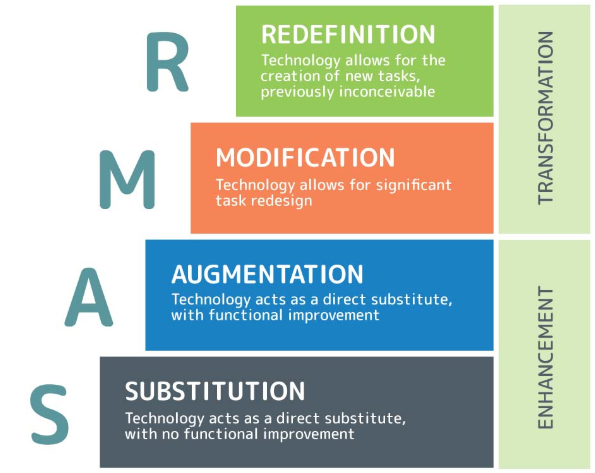
As a first-year Permission to Teach Food Technology teacher, my use of digital technology to date has largely operated at the Modification level of the SAMR model. As this stage, technology is used to significantly redesign learning tasks in ways that enhance student agency, collaboration, and higher-order thinking, rather than simply substituting traditional practices (Phillips, 2015; Common Sense Education, 2016).
In my year 10-11 Food Technology classes, students engage in sensory analysis tasks where they document observations using digital tools, incorporating photographs, graphs, comparisons and reflective questions. These tasks extend beyond Augmentation by enabling deeper analysis and synthesis of practical and theoretical knowledge. Similarly, research-based tasks require students to create presentations using PowerPoint or Canva platforms, where they integrate visuals, embedded videos, data representations, and referenced sources, demonstrating transformed learning outcomes rather than direct replacement of written reports.
Collaborative brainstorming using Google Jamboard further reflects the Modification stage as students construct ideas in real time, an approach that would be difficult to replicate without the technology (Marcovitz & Janiszewski, 2016). While I am beginning to move into the Redefinition stage through assessment tasks such as presenting their PowerPoints to a wider audience and completing design briefs developing new food product concepts with authentic constraints and considerations, my practice currently sits most consistently at the Modification level. This level is appropriate for my career stage, providing a strong foundation for purposeful progression toward Redefinition.
References:
M. Phillips. (2015). Digital technology integration. In Henderson, M. & Romeo, G. (eds) Teaching and Digital Technologies: Big Issues and Critical questions. Melbourne: Cambridge University Press.
Marcovitz, D., & Janiszewski, N. (2016). Technology, models, and 21st-Century learning: How models, standards, ad theories make learning powerful. In Proceedings of Society for Information Technology & Teacher Education International Conference. (pp. 721–726). AACE.
3P Learning. (n.d.). Connecting the SAMR model to classroom practice. https://www.3plearning.com/blog/connectingsamrmodel/
Common Sense Education. (2016). Introduction to the SAMR model [Video]. https://d1pmarobgdhgjx.cloudfront.net/education/Intro_to_SAMR_model_RB2016.mp4
Create Your Own Website With Webador