Week 11: Ethics and Technology
Produce a diagram that presents the important issues in relation to digital ethics; citizenship; law; and/or cyberbullying.
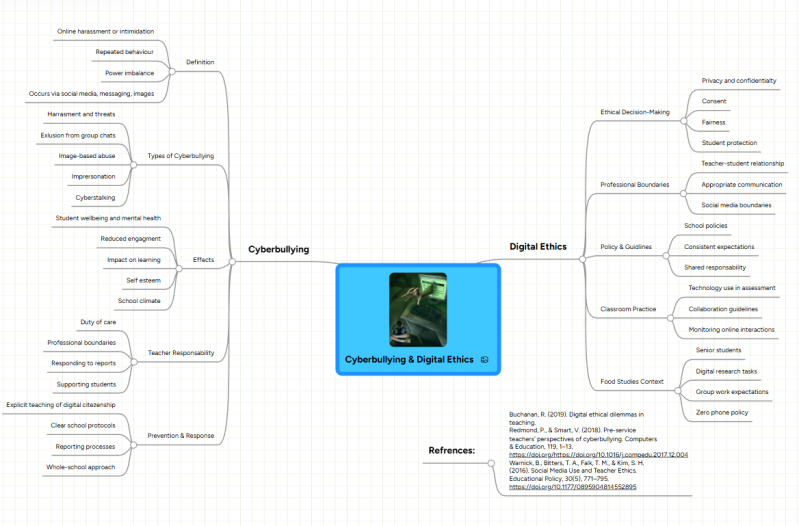
This concept map explores the interconnected issues of digital ethics and cyberbullying within a secondary school context. Creating the map highlighted the significant overlap between student wellbeing, teacher responsibility, and school-wide policy. One key learning was the extent to which cyberbullying, although often occurring outside school hours, remains an ethical concern for educators due to its impact on learning and student wellbeing (Redmond & Smart, 2018).
The readings emphasised that ethical decision-making in digital contexts is rarely clear-cut. Buchanan (2019) notes that teachers frequently operate in grey areas where professional judgment, policy and care of students intersect. I also gained a stronger understanding of the importance of shared responsibility. Rather than placing ethical decision-making solely on individual teachers, Warnick et al. (2016) argue for clear guidelines and collective approaches across school communities.
Reflecting on my own teaching context in senior Food Studies, the schools zero phone policy reduces some risks but does not remove the need for explicit teaching of digital citizenship. When technology is used for collaboration or assessment, clear expectations around ethical communication and respectful behaviour remain essential.
Reference:
Buchanan, R. (2019). Digital ethical dilemmas in teaching.
Redmond, P., & Smart, V. (2018). Pre-service teachers’ perspectives of cyberbullying. Computers & Education, 119, 1–13. https://doi.org/https://doi.org/10.1016/j.compedu.2017.12.004
Warnick, B., Bitters, T. A., Falk, T. M., & Kim, S. H. (2016). Social Media Use and Teacher Ethics. Educational Policy, 30(5), 771–795. https://doi.org/10.1177/0895904814552895
Create Your Own Website With Webador